


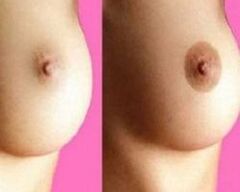
Many women associate breast or nipple enlargement with improving their visual attractiveness.Meanwhile, correction of inverted nipples aims to resolve functional defects of the mammary gland.Inverted nipples prevent the baby from latching normally, and solving the problem of how to stretch the nipples is the solution to many women's breastfeeding problems.
A woman's nipples becoming smaller or flatter than average may be a sign that her milk ducts are shortening.In this case, the nipple may not rise above the skin at all, but will contract when subjected to mechanical irritation;Such nipples react poorly to changes in temperature.However, in most cases this does not affect the child's feeding.
It's even worse if the nipple is inverted and reduced in size to the point where the baby can't latch on with his lips.In order for your baby to properly latch on to the nipple while feeding, nipple enlargement surgery may be needed.
The main causes of small or inverted nipples are genetics, short or underdeveloped milk ducts, underdeveloped or impaired genitalia, frequent wearing of tight bras, especially in adolescence, and breast tumors.
Methods to correct inverted nipples
There are several methods used to correct small or inverted nipples:
- Surgical methods to correct the shape of the nipple (with and without intersection of the milk ducts);
- vacuum nipple traction using attachments;
- nipple massage;
- tattooing (cosmetic correction to visually increase the size of the nipples).
Surgical techniques differ for women who do and do not plan to breastfeed.If the woman does not intend to breastfeed, then only nipple plastic surgery is performed, in which the too-short milk ducts that hold the nipple under the skin are completely cut;After such an operation, future breastfeeding is impossible.
But if surgery is performed to improve breastfeeding, the integrity of the milk ducts is maintained and through an incision at the base of the areola, only the connective tissue that holds the inverted nipple under the skin is cut;These tissues attach the milk ducts to the nipple.The difference between the interventions also lies in the price - cosmetic surgery to remove the milk ducts is simpler and cheaper.And the choice of anesthesia - local or general - in any case depends on the doctor.
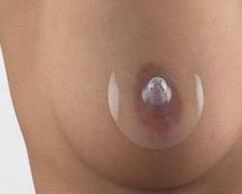
Vacuum nipple stretching is a relatively new method that involves wearing special accessories that help stretch the nipples using a vacuum.The nozzle is placed over the nipple and air is sucked out from the other side using a syringe.The device - the cap is small in size and invisible under clothes, but when worn continuously for at least 8 hours a day for 2-3 months, you can obtain stable results in nipple traction.But before you start wearing it, you need to consult a mammologist, and if you feel any discomfort or pain, you should stop using it.
Women can perform nipple massage on their own, even at home, after learning the basic techniques of this technique from a specialist.But such correction must begin in adolescence, when the mammary glands are developing and are quite easily affected.
Tattooing is not a medical method, but a cosmetic correction method, in which a pigment is injected under the skin, visually increasing the size of the nipple.The procedure is very painful, but high-quality tattoos allow you to achieve complete similarity in the shape of the nipple after correction with a conventional nipple.